Breaking was not born in a studio or on a stage. It was born at neighbourhood parties in the Bronx, New York, in the 1970s, where music, dance and the nerve of local kids collided.
The Bronx, 11 August 1973
The story is tied to a near-mythical date: on 11 August 1973, Cindy Campbell threw a back-to-school party in the community room at 1520 Sedgwick Avenue, with her brother DJ Kool Herc on the decks. The address is often called the “birthplace of hip-hop”.
Herc noticed something simple: dancers waited for the “break” of a record, the instrumental part, usually just drums and bass, and that is when they went all out. To stretch that moment he played two copies of the same record on two turntables and switched between them, a technique known as the Merry-Go-Round. Dancers suddenly had a section of their own. Those who danced to the break became b-boys and b-girls, and the dance became breaking.
Where the name comes from
Pioneers say “break” also came from African American slang of the late 1960s and early 1970s, where to “break” meant to reach a limit, to burst with energy. “Breakdance” was a label spread later by the media and the film industry, and many in the community prefer plain breaking today. “Breakdance” is still widely used, so you will hear it a lot.
The building blocks of a set
- Toprock: steps danced standing up, usually the start of a set. Style, attitude and musicality show here. The move down to the floor is called a drop.
- Footwork (also downrock or floorwork): movement on the floor with the hands supporting the body. The 6-step and its variations are the foundation.
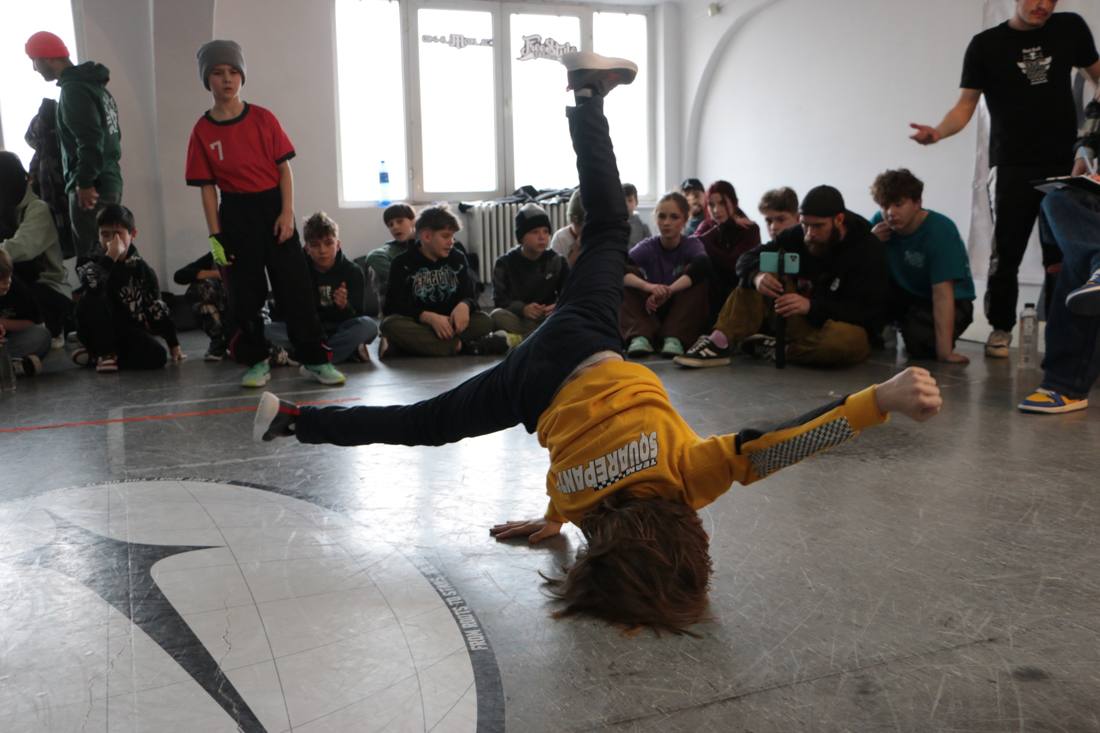
- Power moves: acrobatic moves built on momentum, strength and control, such as the windmill, swipe, backspin, headspin or flare.
- Freezes: poses held off the ground, on the hands or head, used to hit a musical accent or to finish a set.
A good dancer does not rattle these off like a list of tricks. They link them, to the music, and make them their own. That is why people say breaking is about your own voice.
From neighbourhood dance to crews
You can find echoes of older African American dance forms such as juba, tap and jazz in breaking, and many dancers cite the Nicholas Brothers and James Brown as influences. As the movement grew, crews appeared: groups that trained together, challenged each other and defended their name in battles. Rock Steady Crew, later led in Manhattan by Richard “Crazy Legs” Colon, became one of the best known. The Mighty Zulu Kings and the Universal Zulu Nation, founded by Afrika Bambaataa, tied the dance to a wider message: an alternative to street violence.
The 1980s: the screen makes the dance global
In 1982 Rock Steady Crew toured Europe (the Roxxy European Hip Hop tour), performing in London and Paris. In 1983 they appeared on television, and films like Flashdance, Breakin’ and Beat Street (both 1984) took breaking to cinemas around the world. The dance reached Japan, France, Germany and Canada, and in the Soviet Union videotapes circulated from 1984. By around 1986 mainstream interest cooled, but the community never went away.
The comeback: battles, competitions, local scenes
In the 1990s competitions gave the scene a global structure. Battle of the Year started in Germany in 1990, and its first international final took place in Hanover in 1991. Red Bull BC One, a 1vs1 competition, began in 2004. Other landmark events include Freestyle Session, The Notorious IBE, the UK B-Boy Championships and BBIC in Korea. In South Korea, 1997 is seen as the “year zero” of the scene, and Expression Crew won Battle of the Year in 2002.
Cultural impact: art, sport and community
Breaking has left its mark on film (Wild Style, Beat Street, the Step Up series), documentaries (Style Wars, Planet B-Boy), television, advertising and video games. The deepest impact is social, though: a kid with no access to expensive gyms can start with a patch of floor and a speaker. It is also where art and sport meet: you need musicality, expression and creativity, but also strength, endurance and physical preparation. That very mix is what eventually carried breaking to the Olympic Games. You can read how in the next article.
And here in Bucharest
At Space Cadets – Breaking Club, a Break4Kids project, we teach exactly these foundations: toprock, footwork, freezes and musicality, in groups for kids aged 6+ and for adults. The first class is free.
Sources
Summarised in our own words from the sources above. If you spot a mistake, write to us and we will fix it.
Keep reading
Contact
Space Cadets – Breaking ClubStr. Spătaru Preda nr. 12, Sector 5, București
WhatsApp / phone: 0758 484 381
E-mail: scoaladebreakingspacecadets@gmail.com
Instagram · Facebook · TikTok · YouTube